Exploring strange lands
Omenland is a game of exploration. A connect the dots without rules. It is history in the making.
This project springs from a desire for meaning. It is not necessarily about finding 'truth', though we might rub up against it here and there as we explore the lands which are generated for us by layers of history.
Meaning is created by conscious beings. It is a creative act which we cannot help but perform ceaselessly. The world is not a collection of matter with mathematically defined co-ordinates and trajectories. It is meaning. Our history is all the meaning generation that has gone on before now. That's my working hypothesis anyway. Lack of meaning is a curse. It makes us weak.
Mouthfuls of dust
When I was learning history at school, I often found myself wondering: "You say it happened like this, and for these reasons. But did it?" This first question opened the door to others: What else was going on at the time? What occupied the thoughts of the people? What did the world look like to them? What did they imagine the future would be like? There were no answers, the questions became overwhelming.
I wanted an intimate connection with the past, but none was on offer. Instead, the history served up with such reverence in class was like a meal of dust. Endless grey dust, spooned in till you were sick of it. If the actual past had been like this we would all have lain down and died from the tedium of it. I gave up on ever making sense of history. You may have had a similar experience.
Though I turned my back on the dust tsunami, I continued to wonder how 'we the people' could make a real, human connection to all those real humans that existed back then? It HAS to be possible. But how?
DeLanda, the Polish system, abstraction
Should I invest hours and days, weeks of time, maybe even years, reading all the books on the history of x? If I do that, how do I know which sources to trust? Do I need to read the books about the books, and their authors? This idea leads to infinite regression. And, quite quickly, more despair. A pattern emerges!
Then, one day, I found this book, by Manuel DeLanda: 1000 years of nonlinear history. It's a great read. The upshot for me was this: You can think of history as a physical process, like rock formation. Some rocks are volcanic, some sedimentary, and so on. There is a raw data aspect to it, like geology.
So I began to think, how can we bring this way of thinking to life? How can we use this geological metaphor to stop us from turning the meal of history into dust before it even gets to our spoon? We need some way to put all the various histories together, art, science, politics, medicine, conflicts, battles, diseases, companies, ships, trade... All of it in one huge geology, then just dig in and see what we come out with.
The next piece of the puzzle came in a book about timelines, Cartographies of time.. The authors discuss the 1850 publication by American transcendentalist Elizabeth Palmer Peabody, of "The Polish-American system of Chronology." This, essentially, was a square of gridded paper, each 10x10 sheet representing 100 years. Along with the grid came a set of paints and conventions used to color the grid squares depending on the particular types of event which dominated the given year's square. Red for war, a triangle for revolution and so on.
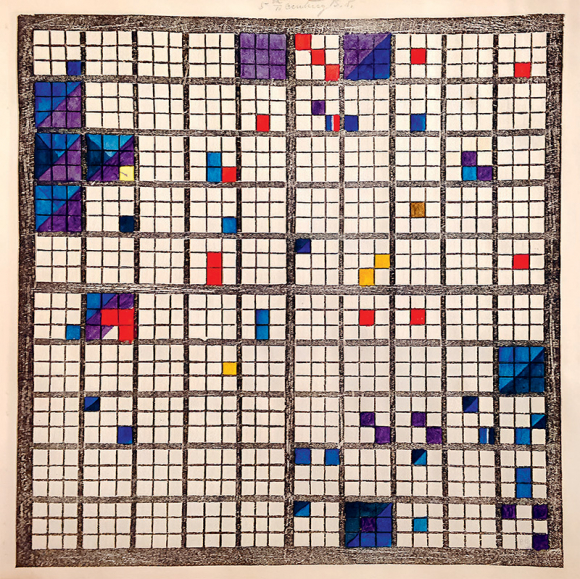 the polish system
So now we have geology, and a grid system. The final component was a little more abstract but fed on the Polish System very nicely. This piece was the Game of Life, described by Wikipedia as 'a cellular automaton devised by the British mathematician John Horton Conway in 1970.' Now, the amazing thing about this game is that it shows how a very simple system - a grid plus a series of rules, which play out on a turn by turn basis - can give rise to something which looks very much like LIFE.
Connect the dots
Omen land is a geologically layered version of the Polish System, which evolves like the game of life. The nice thing about this abstraction from historical events to a terrain is that you can enjoy the hills and valleys, the colours and shapes as they march through time. Without having to care about what the events are, when they are, or who was involved... Just a shape or a pattern that takes your fancy. But it turns out, that shape or pattern has been created by historical events of a certain type, clustering in a given time period.
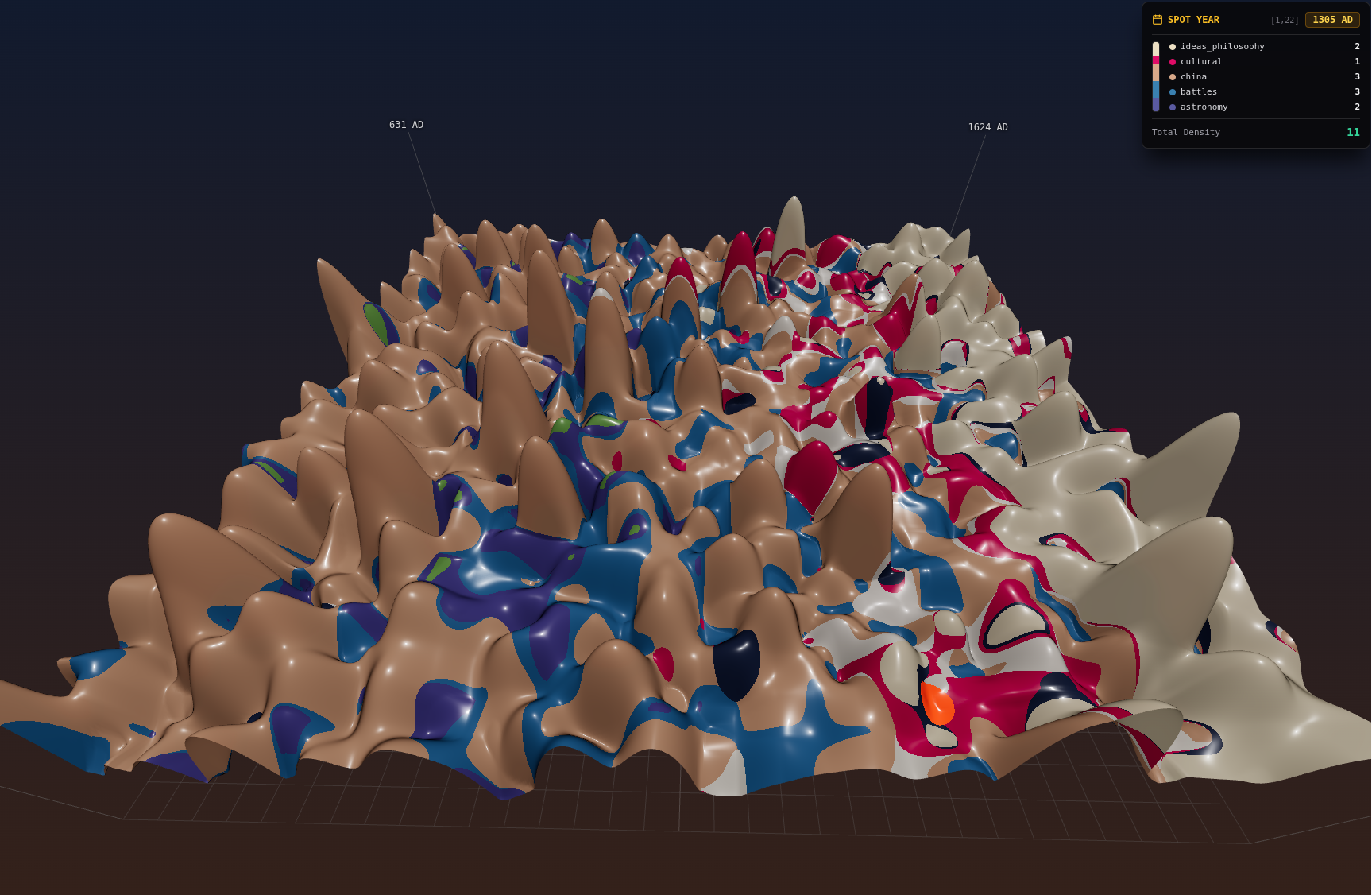 The omen land
Grab those events, grab some other events, chuck in one or two more. You might have picked up some development in physical chemsitry, coinciding with a revolution in the visual arts, a secret society dealing in darkness, a solar eclipse... All together, in the same moment. Or strung in a chain through time. It happened, but why?
In the way we all do with our own personal histories, you can make stories up about these events. A kind of 'connect the dots' where you ignore the rules, get lost in the dots. And when you sit back, maybe there's a masterpiece. Maybe there isn't.
That process of getting lost in the doing, that was the real objective. It seems to me that only at that point, once you've shaken off the rules, given the academic eye of Sauron the slip, can you be creative. With omen land you'll step into the dark of the past, and bring something new back with you. This could be beautiful or terrible, or both. I hope you enjoy the process and look forward very much to seeing the treasures you bring back.
This short article attempts to give you the 'why' of the omen land. If you want a tutorial, the 'how' can be found here.